
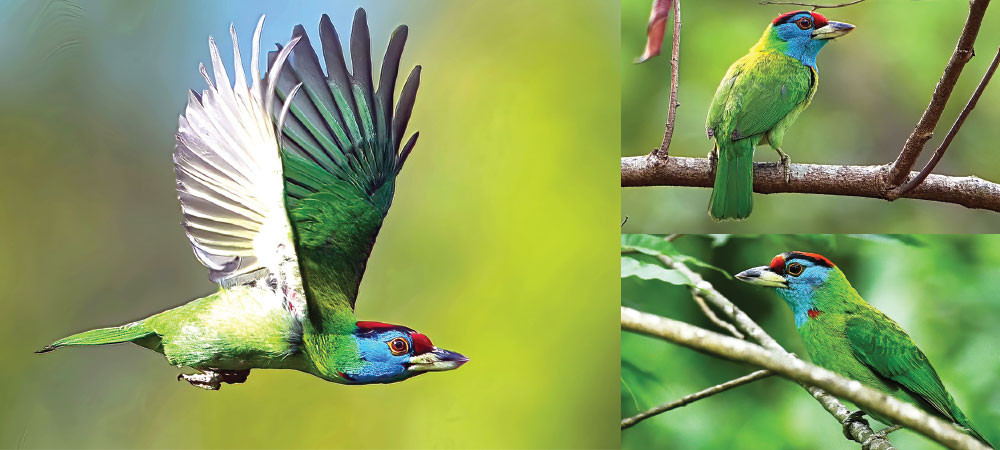
The blue-throated barbet (Silopogon asiaticus) is one of Nepal's most striking birds, admired for its vibrant blend of colours. Its bright green body, turquoise-blue throat, red forehead, yellow-and-red crown and white facial markings create a remarkable appearance.
Despite its colourful plumage, the bird blends seamlessly into the dense forest canopy, where shades of green and dappled light provide perfect camouflage.
Hidden among thick foliage, it is often heard long before it is seen. Known in Nepali as Kuthurke, the blue-throated barbet belongs to the barbet family, a group of tropical birds recognised for the stiff bristles around their heavy, toucan-like beaks.
They are closely related to toucans and woodpeckers. During spring and the early monsoon, the forests echo with their loud, rhythmic calls. Pairs often sing in duet, strengthening their bond while also defending their nesting territories from rivals.
The species is widely distributed across Nepal, inhabiting elevations from about 200 metres to 2,100 metres above sea level. It occurs in the Himalayas, the mid-hills and the Tarai, occupying tropical evergreen and deciduous forests, secondary woodlands, orchards—particularly those with fig (Ficus) trees—and even urban green spaces.
It can also be observed in many of Nepal's national parks, buffer zones and community forests. Although largely a resident species, some populations move to lower elevations during winter. The breeding season, from March to July, is the period when the bird is most vocal.
Its unmistakable "took-took-took" or "kut-r-ruk, kut-r-ruk" call may be repeated more than 90 times a minute. When one bird stops calling, another often begins immediately, creating a continuous chorus across the forest.
The sound can travel up to 300 metres, making the call the easiest way for birdwatchers to locate this otherwise elusive species.
The blue-throated barbet possesses expandable skin pouches, known as gular sacs, on either side of its throat. When calling, these sacs inflate and act as natural resonating chambers, amplifying the sound so it carries through the dense canopy.
This adaptation has earned the species a reputation as one of the most persistent singers of the spring breeding season.
Adults measure about 22–23 centimetres in length and weigh between 61 and 103 grams. Along with their vivid blue throat, they have bright green underparts, a red forehead, a yellow-and-red crown, white stripes on the head, small white and red markings near the eyes, a stout pale-based bill and a short tail.
The breeding behaviour of this bird is equally fascinating. During spring, pairs perform courtship displays that include singing duets and feeding one another.
They excavate nesting cavities in dead or decaying tree branches using their powerful beaks, usually laying two to four eggs in May. Because these abandoned nest holes later provide shelter for other birds, insects and small mammals, the blue-throated barbet is regarded as an important ecosystem engineer. Its diet consists mainly of fruits, especially figs, berries and mangoes, although it also feeds on insects such as crickets, mantises, ants, cicadas, dragonflies, locusts, beetles and butterflies.
By dispersing seeds after feeding on fruit, the bird plays a vital role in forest regeneration and maintaining plant diversity.
Its insect diet also contributes to natural pest control. The blue-throated barbet was first described by English naturalist and ornithologist John Latham in 1790. In Nepal, the species has been documented since the nineteenth century.
After 1990, surveys recorded 18 individuals in Koshi Tappu Wildlife Sanctuary (Baral, 2009). Of the roughly 80 to 85 barbet species found worldwide, six have been permanently recorded in Nepal. Globally, the species occurs in Nepal, Bangladesh, Bhutan, China, India, Laos, Myanmar, Pakistan,
Thailand and Vietnam. The International Union for Conservation of Nature (IUCN) classifies the blue-throated barbet as a species of Least Concern.
Nevertheless, it faces growing threats from habitat loss caused by deforestation, urban expansion and agricultural development. Illegal trapping, hunting with slingshots and the indiscriminate use of pesticides also pose risks to its survival.
Conserving forests and mature trees remains essential to ensuring that the unmistakable voice of the blue-t hroated barbet continues to announce the arrival of spring across Nepal's woodlands.
(The author is a wildlife photographer. Photos used in this article are by the author.) - TRN Online